
If you've used our quote form, you've noticed the material dropdowns are oddly specific — A1008 CSB, A36 PO, 5052AL, thicknesses like 0.38" instead of 3/8". There's a reason. Those lists come straight out of PolygonLogix, the quoting and nesting software we run the shop on. And PolygonLogix exists because of a problem that started right here on our floor.
The problem: half a day to quote a job
For most of JFD's history, quoting looked like this. A customer sends a purchase order and a folder of DXF files. Whoever's quoting that day opens the files one at a time, pulls up a spreadsheet, looks up material prices, measures cut lengths, eyeballs how the parts will nest on a sheet, counts pierces, estimates setup and labor, adds margin, and types it all into a quote document. For a ten-part job, that's half an hour. For a hundred-part job across several materials and thicknesses, it's half a day.
Half a day is a long time in a shop this size. It's half a day someone isn't on the floor, isn't running a machine, isn't making parts. And the customer is waiting the whole time, often with the same file sitting in three other shops' inboxes. Whoever quotes first, wins.
What was on the market
There were two kinds of software to fix this, and neither fit. The big CAM and nesting packages that run the machines in large fab shops cost well over ten thousand dollars per seat, plus annual maintenance, and assume you have a dedicated programmer. The newer online quoting tools were affordable, but they stopped at the quote — they couldn't nest a sheet or send a program to a machine, so you'd still be running two or three programs to get one job from PO to cut parts. And your data lived on someone else's server, on a subscription, for as long as you kept paying.
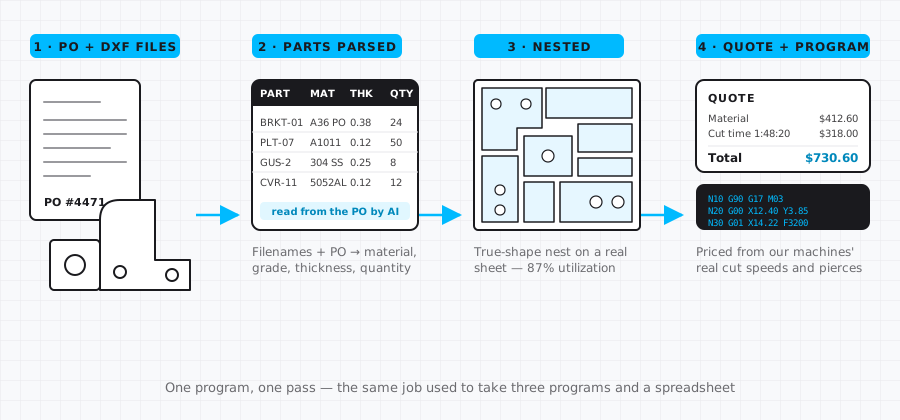
What we wanted was simple to say and apparently impossible to buy: one program that reads the customer's files, prices the job the way we'd price it by hand, nests the parts on a real sheet, and produces the program our machines run. Desktop software. Our data on our machine. Pay for it once.
So Nick built it
Nick's job at JFD has always been finding the places where the team gets bogged down and making them go away. Quoting was the biggest one. So the first version of PolygonLogix had one job: let whoever's quoting do it faster. Load the DXFs, apply our actual material prices, and price cut time using the real feed rates and pierce times off our machines instead of a guess. That alone turned a thirty-minute quote into a two-minute one. Then the obvious next problem showed up — a quote is only as accurate as its nest — so nesting came next. Then, since it already had the nest, why not post the program straight to the machine?
Every feature after that came from watching the team hit the same wall on an ordinary Tuesday. Purchase orders arrive as PDFs with parts listed one way and files named another way, so PolygonLogix learned to read the PO and match parts to files by itself. Material shows up on the rack in half-used sheets, so it tracks remnants and quotes against what's actually in the building. We run a CO₂ laser, a fiber laser, and two waterjets that all cut differently, so it keeps a tech table for each machine and knows which one a job belongs on.
The two-decimal thing: PolygonLogix keeps every thickness at two decimals — 3/8" is 0.38, 5/8" is 0.63, 11 gauge is 0.12 — so nine hundred-plus material entries stay sortable and unambiguous. That convention now runs through our quote form, our CSV exports, and this blog. Here's the longer explanation.
What it changed for our customers
- Quotes come back within a business day — usually the same day — because the part that used to eat an afternoon now takes minutes.
- Pricing is consistent. The same part quoted in March and in September is priced the same way, from the same machine data, not from whoever's memory of the last job.
- Material goes further. True-shape nesting packs more parts on a sheet than a person laying them out by eye, and less scrap means a lower material line on your quote.
- Fewer handoff errors. When a PO says 24 pieces of 3/8" A36 and the file's named something else entirely, the software flags it instead of someone catching it at the machine.
It's also why our quote form works the way it does. Every dropdown matches the PolygonLogix material database, and every submission generates a structured file the software reads directly. Pick from the list, and your quote starts the moment you hit Submit.
From our floor to other shops
Somewhere along the way it stopped being an internal tool. Other shop owners asked what we were using. The answer was "something Nick built," which turned into "can I try it," which turned into a product. PolygonLogix is now available to other fabrication shops running fiber laser, CO₂ laser, waterjet, or plasma — still a desktop program, still your data on your own machine, still a one-time license instead of a subscription.
If you run a shop and the quoting story above sounds familiar, Nick wrote the longer version of why he built it at polygonlogix.com. And if you just want parts cut, the software's already working for you — send us your files.
Ready to Start Your Project?
Send us your files and we'll get you a quote — usually within one business day.
Request a Quote